
MATH
4th Grade Units
Unit 1: Place Value & Whole Number Operations
Read and write a multi-digit whole number using base ten numerals and expanded form
Recognize a digit is ten times greater
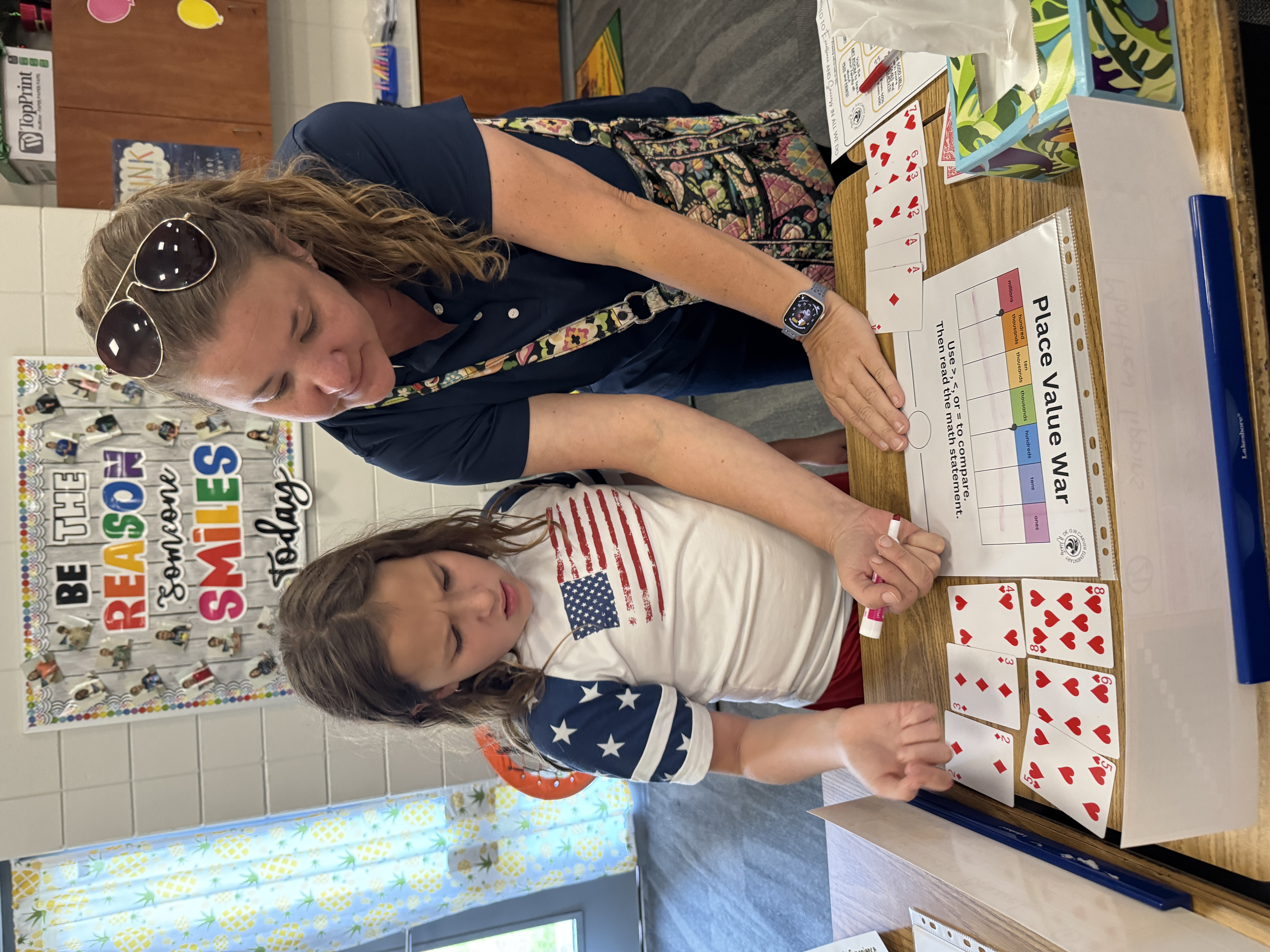
Compare and order multi-digit numbers
Round multi-digit whole numbers
Addition and subtraction of multi-digit whole numbers
Solve multi-step problems using addition and subtraction
Measure time and objects; analyze graphical displays
Mathematical Practices
Unit 2: Patterns & Algebraic Reasoning
Generate and analyze patterns, including those involving shapes, input/output diagrams, factors, multiples, prime numbers, and composite numbers
Measure time and objects; analyze graphical displays
Mathematical Practices
Unit 3: Multiplication & Division
Interpret, model, and solve multiplicative comparisons
Solve multiplication equations with a number up to four digits with a one-digit number
Solve multiplication equations with two-digit numbers
Solve division equations involving up to four-digit dividends and one-digit divisors
Solve division equations where remainders must be interpreted
Solve multi-step problems involving addition, subtraction, multiplication, and division
Measure time and objects; analyze graphical displays
Mathematical Practices
Unit 4: Fractions & Decimals
Add, subtract, and compare fractions using part-whole strategies and visual models
Add, subtract, and compare fractions with denominators of 10 and 100 using part-whole strategies and visual models; relate fractions with denominators of 10 and 100 to decimals
Measure time and objects; analyze graphical displays
Mathematical Practices
Unit 5: Angles
Investigate, estimate, and measure angles.
Mathematical Practices
Unit 6: Geometric Reasoning
Explore, investigate, draw, and identify points, lines, line segments, rays, angles (right, acute, obtuse), perpendicular lines, parallel lines, and lines of symmetry in two-dimensional shapes.
Classify, compare, and contrast polygons, based on lines of symmetry, parallel and perpendicular lines, and angles.
Solve problems involving the area and perimeter of composite rectangles involving whole numbers with known side lengths.
Mathematical Practices
5th Grade Units
Unit 1: Investigating Volume of Solid Figures
Investigate volume of right rectangular prisms using unit cubes.
Discover how volume can be found using properties of right rectangular prisms.
Write, interpret, and evaluate numerical expressions that represent volume.
Unit 2: Building Conceptual Understanding of Place Value Using Measurement & Data Reasoning
Explain the relationships between values of digits in numbers involving fractional comparison.
Explain patterns when multiplying and dividing by powers of ten.
Convert among customary and metric measurement units to explore real-life problems.
Ask and answer questions based on data to solve relevant problems.
Unit 3: Building Conceptual Understanding of Multiplication & Division with Whole Numbers
Fluently multiply and divide multi-digit whole numbers to solve real-life problems.
Write, interpret, and evaluate numerical expressions to represent real-life problems.
Ask and answer questions based on data to solve relevant problems.
Unit 4: Building Fraction Understanding
Compare and order fractions with different numerators and denominators.
Model addition and subtraction of fractions and mixed numbers with unlike denominators to solve real-world problems.
Ask and answer questions based on data represented with a dot plot to solve relevant problems.
Unit 5: Making Sense of Fraction Multiplication and Division
Solve and explain problems involving division of whole numbers with fractional quotients.
Model and reason about multiplication of fractions and whole numbers to solve real-world problems.
Model division of unit fractions and whole numbers to solve real-world problems.
Unit 6: Extending Place Value and Working with Decimals to Solve Problems
Read, write, compare, and order decimal numbers in standard and expanded forms.
Use place value reasoning to round decimal numbers.
Solve problems involving addition and subtraction of decimal numbers.
Ask and answer questions based on data to solve relevant problems.
Unit 7:Exploring Geometry & the Coordinate Plane
Generate patterns and identify relationships between them by completing a table.
Represent problems by plotting points in the coordinate plane.
Examine and classify polygons and rectangular prisms into categories and subcategories based on their properties.